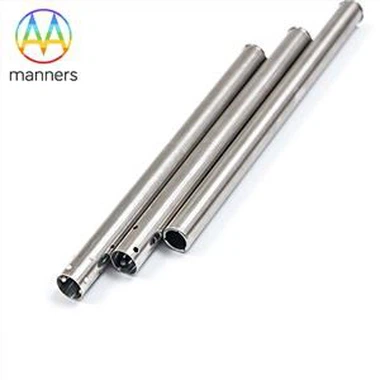
Precision Manufacturing And Quality Control Of The 22G Tuohy Needle
Jun 22, 2026
A seemingly simple 22Godies stringent materials science and precision manufacturing. Every step, from raw material to finished device, impacts patient safety.
1. Material Selection: Grade 316L Stainless Steel
Medical Grade 316L or 304 Stainless Steel.
- .
- Criticality for 22G: For such a fine diameter, the material must be rigid enough to prevent buckling during insertion yet ductile enough to avoid brittle fracture upon hitting bone. Top manufacturers conduct per batch.
2. Laser Cutting and Electropolishing
The needle tip geometry is the heart of the manufacturing process.
- Modern techniques use high-energy laser beams to form the J-tip and back-eye. This replaces mechanical grinding, eliminating macro-burrs.
- Laser cutting leaves behind a heat-affected zone (oxidation). EP uses electrochemical dissolution to preferentially remove microscopic peaks and oxides, achieving a mirror-smooth finish.
- For the 22G needle, the internal lumen roughness must be controlled to Ra <= 0.1 μm to ensure zero-friction catheter passage and prevent plastic particle shedding.
3. Ultrasonic Cleaning and Cleanroom Packaging
Contaminants pose severe risks (inflammation/granulomas).
- Multi-Stage Ultrasonic Cleaning: Uses cavitation to blast microscopic metal debris and cutting oils from deep within the lumen.
- Class 10,000 or Class 100 cleanrooms.
- .
4. Final Inspection and Testing (100% QC)
- Microscopic check for rust, scratches, or deformation.
- Penetration force measured through standardized silicone membranes.
- Verifies consistent inner diameter by measuring fluid throughput under pressure.
- Actual insertion of a standard catheter to test smoothness.
- Tensile testing to ensure the hub does not detach from the cannula under stress.
The 22G Tuohy needle is far more than a piece of metal tubing; it is a meticulously crafted life-saving instrument.

في المادة التالية : كيف يحقق العلاج بالإبر الدقيقة توصيل الدواء بشكل غير مؤلم حقًا